I never heard of a single accusation against an anti-popish Christian in the 1500 years of open persecutions against the Vaudoises (Novatian, Patereni, Anabaptists, Picards, Albigenses, etc.), to profess the belief in Reincarnation. But at the opposite, if they were slaughtered it was for well completely different beliefs....
http://en.wikipedia.org/wiki/Origen
Anathemas (544, 553)
While Patriarch Mennas of Constantinople condemned Origen and a form of apocatastasis at the Synod of Constantinople (543); experts are divided whether the Second Council of Constantinople (the Fifth Ecumenical Council) in 553 ratified the condemnation authentically as "It is [only] certain that the council opened on 5 May, 553, in spite of the protestations of Pope Vigilius, who though at Constantinople refused to attend it, and that in the eight conciliary sessions (from 5 May to 2 June), the Acts of which we possess, only the question of the Three Chapters is treated."[13] Many heteroclite views became associated with Origen, and the 15 anathemas attributed to the council condemn a form of apocatastasis along with the pre-existence of the soul, animism (a heterodox Christology), and a denial of real and lasting resurrection of the body.[59] Some authorities believe these anathemas belong to an earlier local synod.[60] The anathema against Origen in his person, declaring him (among others) a heretic, reads as follows:
If anyone does not anathematize Arius, Eunomius, Macedonius, Apollinaris, Nestorius, Eutyches and Origen, as well as their impious writings, as also all other heretics already condemned and anathematized by the Holy Catholic and Apostolic Church, and by the aforesaid four Holy Synods and [if anyone does not equally anathematize] all those who have held and hold or who in their impiety persist in holding to the end the same opinion as those heretics just mentioned: let him be anathema.[61](...........)
Origen in the 1970s
In Reincarnation in Christianity (1978), theosophist Geddes MacGregor asserts that Origen believed in reincarnation and taught about it, but that his texts written about the subject have been destroyed.[65]
(......)Origen is regarded by the Roman Catholic Church as a Church Father, but not a Saint.[73]
From:
THE HISTORY OF THE
CHRISTIAN CHURCH
by William Jones
B o o k s F o r T h e A g e s
AGES Software • Albany, OR USA
Hartland Publications • Rapidan, VA USA
Version 1.0 © 1997
".....Farther, the provincial councils of Toulouse, in 1119, and of Lombez, in
1176, and the general councils of Lateran in 1139, and 1179, do not treat of
them, nor condemn them as Albigenses but as heretics, and when they
paricularize them, they denominate them “bons hommet”—(i.e. good
men)—“Cathari”—“Paterini”—“Publicani,” etc. which shows that they
existed before they were generally known as Albigenses. It is also proved,
from their books, that they existed as Waldenses, before the times of Peter
Waldo, who preached about the year 1160. Perrin, who wrote their
history, had in his possession a New Testament in the Vallese language,
written on parchment, in a very ancient letter, and a book entitled in their
language, “Qual cosa sia l’Antichrist”—that is, “What is Antichrist?”
under date of the year 1120, which carries us back at least twenty years
before Waldo. Another book entitled, “The Noble Lesson” —is dated A.D.
1100.
Their enemies confirm their great antiquity. Reinerius Saccho, an
inquisitor, and one of their most implacable enemies, who lived only eighty
years after Waldo, admits that the Waldenses flourished five hundred years
before that preacher. Gretzer, the Jesuit, who also wrote against the
Waldenses, and had examined the subject fully, not only admits their great
antiquity, but declares his firm belief that the Toulousians and Albigenses
condemned in the years 1177, and 1178, were no other than Waldenses. In
fact, their doctrine, discipline, government, manners, and even the errors
with which they have been charged (by the Catholics,) show that the
Albigenses and Waldenses were distinct branches of the same sect, or that
the former were sprung from the latter.4
From the death of Claude, bishop of Turin, who may not improperly be
termed the Wickliff of that city, to the times of Peter Waldo of Lyons, a
considerable period intervened, during which, the history of the disciples
of that great man is involved in much obscurity. They seem to have had no
writers among themselves capable of detailing their proceedings during this
period; or, if any records of their ecclesiastical history were committed to
writing, the zeal of their opponents hath prevented their transmission to
our times. In the writings of their adversaries, indeed, we have abundant
14
proof of their existence, as a class of Christians separated in faith and
practice from the catholic church, and of the multiplication of their
numbers; but of their proceedings in the formation of churches, and of their
order, worship, and discipling, we are very imperfectly informed....."
"....Reinerius Saccho, an
inquisitor, and one of their most implacable enemies, who lived only eighty
years after Waldo, admits that the Waldenses flourished five hundred years
before that preacher."...
1160 - 500 = 660
...aka little more than one century after the " Second Council of Constantinople (the Fifth Ecumenical Council) in 553", where they probably "ratified the condemnation" of Origen's doctrine.
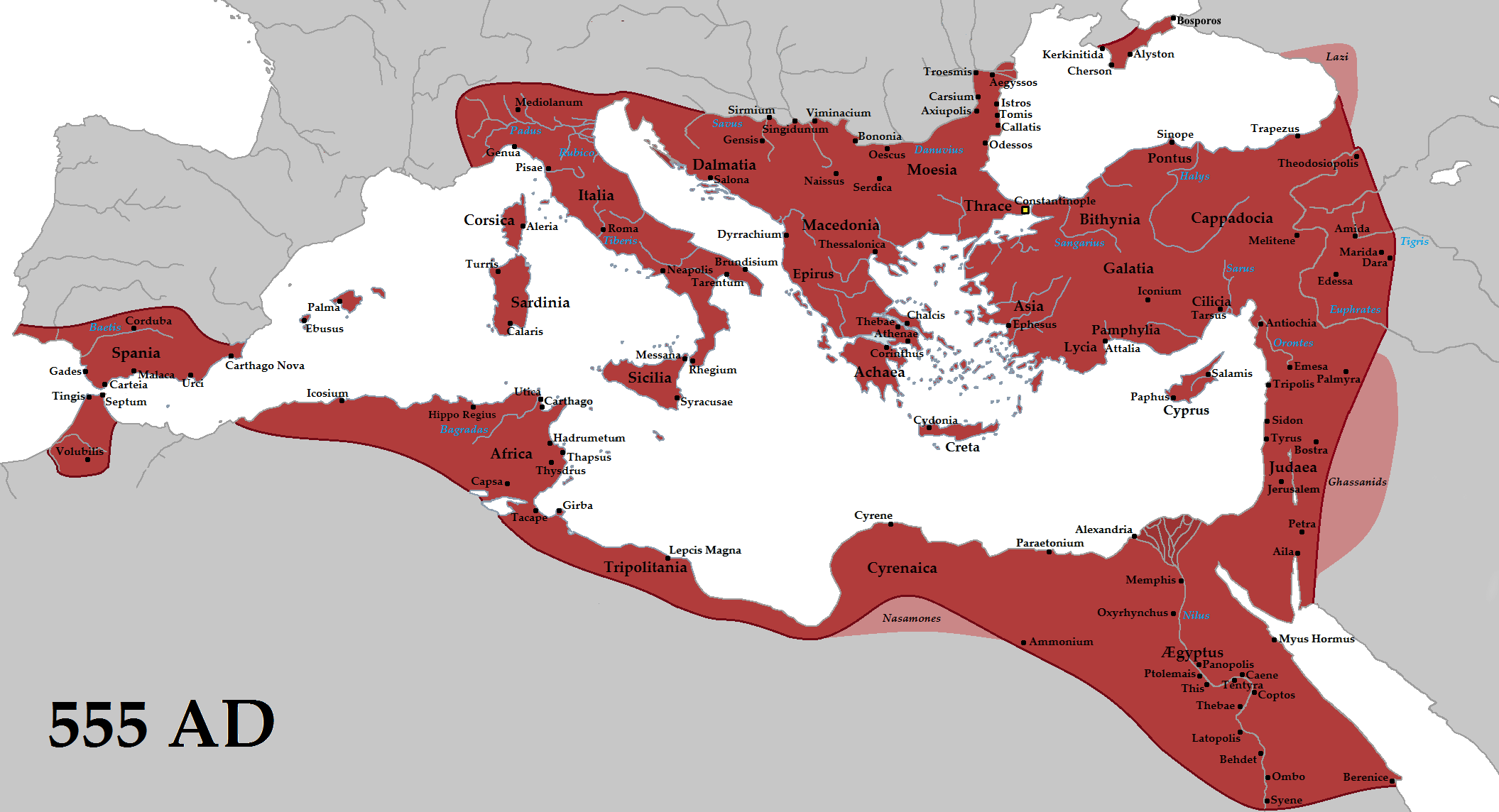
Above image - The Eastern Roman Empire at the age of the Second Council of Constantinople (alleged comdenation of Origen). Notice how it was including North Italy, Piedmont, Lombardy (Milan) and a good part of the Italian Alps.
Origen's theology - allegedly together with his Reincarnationism - if condemned, was condemned because the Catholic church, with her abominable apostasy, cruel blasphemies and satanic heresies was dangerously stirring up a Christian reaction, offering to the true followers of the Christ's Gospel valid arguments in to open the eyes of the people against the incommensurable spiritual corruption of the priests of Rome.
Vaudoises, Patareni, Picards, Anabaptists, etc. didn't suffer the persecution of the church of Rome because they believed in the "transmigration of the souls", but because they righteously believed you have only one life at disposition given by God in order to surrender yourself not to the pope and his evil church, but to the precious blood shed by Jesus Christ the Lord.
"......The country in which we find the earliest of these Protesters is Italy. The See of Rome, in those days, embraced only the capital and the surrounding provinces. The diocese of Milan, which included the plain of Lombardy, the Alps of Piedmont, and the southern provinces of France, greatly exceeded it in extent.[1] It is an undoubted historical fact that this powerful diocese was not then tributary to the Papal chair. "The Bishops of Milan," says Pope Pelagius I. (555), "do not come to Rome for ordination." He further informs us that this "was an ancient custom of theirs."[2]
......." [by James A. Wylie]
Tuesday, June 24, 2014
Anabaptist bread. With Catholic leaven. http://control-avles-blogs.blogspot.it/2014/06/anabaptist-bread-with-catholic-leaven.html
