>
Western Roman Empire (EU) and Putin's Russia (Eastern Roman Empire) has to unite, from the Artic sea to the Arab Peninsula. The Catholicization of Eurasia in the name of the Queen of Heaven aka Gnosis ("virgin Mary" for the masses) proceedes also and especially with the terrorism. Today ISIS is useful to forget what happened only 14 years ago, not in Manhattan but in Moscow.
Well, since 1991 living in a country where if you put the nose in the wrong hole you become food for worms???
Jeffrey Silverman, who is protecting him? CIA? FSB?...
In April 2010 explosive placed on board a Polish TU 154 M by alleged Polish/Western hands murdered Lech Kaczinzki + other 95 people. Russian authorities fully collaborated in the four years of deception after that mass murder, storing the wreckage of the airplane outside in order to let to rain and snow to erase all the traces of explosive. Russian FSB fully collaborated with the responsible of that massacre. Aren't they maybe collaborating with them in Georgia???
If Putin's cronies need of a strong hand to squeeze any kind of opposition within the country, surely they need of an 'external' provocation. They need of some of tangible evidences in order to cry "infiltration!" by the eternal enemy, the USA.
And the USA of the Jesuits is happy to help Putin sending in Georgia some actors ("terrorists") and building some provocations, indeed very coreographed and visible, which can be photographed and exhibited to the Russian media as justification for the Putin's (FSB's) coupe in Moscow. In order to deny that there was really a savage inner repression in the federal republics, the Kremlin needed to exhibit the proof that the instigators of the secession were coming from the international terrorism. Can you deny the collaboration? An exchange between Moscow and Washington. "You supply me with 'CIA' supported Arab/Afghan terrorists, I give you the green light for the invasion of Iraq":
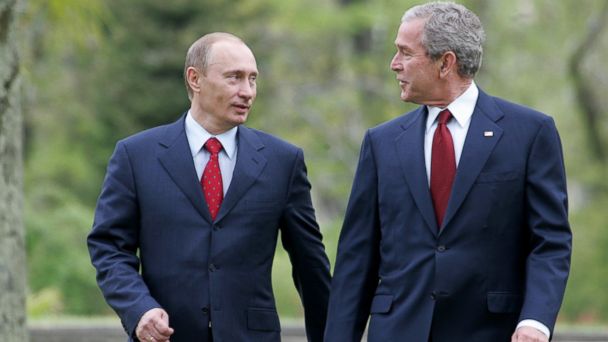
On June 16, 2001, at a press conference in Brdo Pri Kranju,
Slovenia, President Bush is asked about Putin: "Is this a man that
Americans can trust?" Bush replies: "I will answer the question. I
looked the man in the eye. I found him to be very straightforward and
trustworthy. We had a very good dialogue. I was able to get a sense of
his soul; a man deeply committed to his country and the best interests
of his country. And I appreciated so very much the frank dialogue."]
The Putin Murders
URL: http://larussophobe.wordpress.com/putinmurders/
A Brief History of Putintime
But see also:
Saturday, 16 June, 2001, 23:09 GMT 00:09 UK
Bush and Putin: Best of friends
The summit was a success despite unresolved issues
By Caroline Wyatt in Ljubljana
Presidents George Bush and Vladimir Putin have met for the first time and appear to have hit it off.
The two men still differ over enlarging Nato and US missile defence plans, but they exchanged warm words.
They say they found the basis for a relationship of mutual respect.
At the end of their first summit meeting in Slovenia Mr Bush described Mr Putin as a straightforward and trustworthy man.
The Russian leader said he regarded the US as a partner.
Getting on
The summit is being judged a success by both sides even though it leaves
Russia and the US little closer to resolving the issues that divide
them.
The atmosphere here was one of friendly co-operation with the two leaders getting on far better than expected.
The first handshake looked stiff and
awkward, but after well over an hour of talks they came out smiling
with Mr Bush inviting the Russian leader to visit his ranch in Texas.
Mr Bush described their meeting as straightforward and effective.
The warmth of the meeting surprised many
He said it was time to move beyond Cold War attitudes, away from mutually assured destruction towards mutually earned respect.
"I looked the man in the eye. I found him to be very straight forward and trustworthy and we had a very good dialogue.

I looked the man in the eye. I was able to get a sense of his soul
 |
George W Bush
|
"I was able to get a sense of his soul.
"He's a man deeply committed to his country and the best interests of
his country and I appreciate very much the frank dialogue and that's the
beginning of a very constructive relationship," Mr Bush said.
Rapport
Mr Putin also seemed to suggest these two very different leaders had built up a rapport.
Echoing Mr Bush he called the United States Russia's partner. Warm words, unthinkable just a few months ago.
The Russian leader said both their countries bore a special responsibility for maintaining world peace and security.
However he warned that any unilateral action would make that process
more complicated - a signal that difficult discussions on Nato and the
US missile defence system still lie ahead. [end of quote]
See ten years later Biden, a Jesuit-linked guy:
"...Biden held his hand a few inches from his nose. “I said, ‘Mr. Prime
Minister, I’m looking into your eyes, and I don’t think you have a
soul.’ ” (.......) “And he looked back at me, and he smiled, and he said, ‘We understand
one another.’ ” Biden sat back, and said, “This is who this guy is!”.
Yea, you can be sure, also this time Putin and his interlocutor were agreeing, exactly like ten years before:
http://abcnews.go.com/blogs/politics/2014/07/close-encounters-with-vladimir-putin-what-joe-biden-and-george-w-bush-saw/
Bush looked in Putin's eyes and saw the green light to invade Iraq - but there was a difference in the afterward respectively of Moscow Bombings and the 911:
"....In 2000 Sergei Kovalev, then the widely respected head of the Russian
organization Memorial, observed in these pages that the apartment
bombings in Russia in September 1999, which killed three hundred people
and wounded hundreds of others, “were a crucial moment in the unfolding
of our current history. After the first shock passed, it turned out that
we were living in an entirely different country….”1
The
bombings, it will be recalled, were blamed on Chechen rebels and used
as a pretext for Boris Yeltsin’s Kremlin to launch a bloody second war
against Chechnya, a republic in the Russian Federation. They also were
crucial events in promoting Vladimir Putin’s takeover of the Russian
presidency as Yeltsin’s anointed successor in 2000 and in ensuring his
dominance over the Russian political scene ever since.
As John Dunlop points out in The Moscow Bombings of September 1999,
the attacks were the equivalent for Russians of September 11, 2001, for
Americans. They aroused a fear of terrorism—along with a desire for
revenge against the Chechens—that Russians had not known since Stalin
used the supposed terrorist threat as a pretext to launch his bloody
purges of the 1930s. Yet unlike in the American case, Russian
authorities have stonewalled all efforts to investigate who was behind
these acts of terror and why they happened. In the words of Russian
journalist Yuliya Kalinina: “The Americans several months after 11
September 2001 already knew everything—who the terrorists were and where
they come from…. We in general know nothing.”
(........)
Immediately
after the September 13 explosion in Moscow, Putin claimed that the
people responsible for the bombings in the Dagestan town of Buinaksk and
Moscow were most likely terrorists who were connected with Osama bin
Laden and had been trained in Chechnya. Some days later, on September
25, FSB chief Nikolai Patrushev echoed this theme in the pages of the newspaper Moskovskii komsomolets.
Responding to suggestions in the Russian press that his agency was
behind the bombings, he wrote: “The organizers are not some mythical
conspirators in the Kremlin, but completely concrete international
terrorists dug into Chechnya.” The FSB and the
Russian Procuracy later identified the masterminds of all the attacks as
two Arab mercenaries, Al-Khattab and Abu Umar, who were subsequently
killed in Chechnya.
But the official explanations did not quell suspicions about FSB
complicity among liberal, anti-Yeltsin journalists who were already
making their own investigations. Their suspicions were intensified by a
strange incident that occurred on September 22 in the city of Ryazan,
about a hundred miles southeast of Moscow.3
Residents of an apartment complex had reported unusual activity in the
basement and observed that three people in a car with partially
papered-over license plates had unloaded sacks whose contents they
couldn’t make out. A professional bomb squad arrived and discovered that
the sacks contained not only sugar but also explosives, including
hexogen, and that a detonator was attached. After the sacks were
examined and removed, they were sent by the local FSB to Moscow.
The
entire apartment building was evacuated. Local authorities found the
car used by the three who had planted the explosives, a white Zhiguli,
in a nearby parking lot. To their astonishment the license plates were
traced to the FSB. And when they apprehended two of the suspects, it turned out that they were FSB employees, who were soon released on orders from Moscow.
After
a day and a half of silence, Patrushev announced on television that the
apparent bomb had been part of a “training exercise” and that the sacks
contained only sugar. The local Ryazan FSB and
regular police, who had been combing the city for more explosives,
expressed outrage. In the words of one police official: “Our preliminary
tests showed the presence of explosives…. As far as we were concerned,
the danger was real.”
If this incident was in fact just an
exercise, it is difficult to understand why Vladimir Rushailo, the
Russian minister of interior, who headed an antiterrorism commission,
knew nothing about it beforehand. Shortly before Patrushev’s
announcement, Rushailo spoke publicly about the terrorist act that had
been planned in Ryazan and praised the people of that city for thwarting
it. As Dunlop and many others have concluded, the materials discovered
in Ryazan were the makings of a real bomb, and the FSB
was caught in the act. In the light of this evidence, Dunlop writes, it
has become all the more likely that the September terrorist attacks
were also the FSB’s work.
As
Sergei Kovalev, who in 2002 created an unofficial commission to
investigate the bombings, made clear, the authorities put out a great
deal of disinformation but actually did little to refute the claims of FSB
involvement. The trials of those accused of taking part in the Moscow
and Volgodonsk plots were closed, so the evidence against the alleged
terrorists was never made public. (The Buinaksk trial, in which six
persons, all from Dagestan, were found guilty, was public, but, as
Dunlop reports, the investigators routinely used physical coercion to
extort confessions.)
In the first trial of the alleged attackers
in Moscow, which began in May 2001, five residents of the North
Caucasian Republic of Karachaevo-Cherkessia were charged with preparing
the explosives used in the bombs and sentenced to life. At a second
trial, held in 2003–2004, two other defendants from that same republic
were found guilty of terrorism, again with the documents and even the
full sentence in the case kept secret. These same two defendants were
charged with carrying out the Volgodonsk bombings. It is worth noting
that in the Moscow cases, none of the accused had been physically
present in the city around the time of the explosions, and none of those
charged in any of the cases was an ethnic Chechen......"
[for the entire article, in two web pages go to....]
Finally, We Know About the Moscow Bombings
by John B. Dunlop
Stuttgart: Ibidem, 251 pp., €34.90 (paper)
Jeffrey Silverman: How CIA is Working to Help Assad [and Putin]